
Puppy Biting: Why Your Sweet Puppy Turns Into a Land Shark (and How to Survive the Phase)
Week two. Your puppy has discovered your hands, your ankles, and your sleeves — and they are delicious. Here's what's actually happening, and the way through it.
You didn't get a defective puppy
Every puppy owner has the same moment, usually in week two: your sweet, sleepy puppy transforms into a furry piranha with a taste for your hands, your ankles, your sleeves, and — somehow always — the exact moment you sit down. Welcome to the land shark phase. It's the single most common reason new owners think something is wrong with their puppy. Nothing is wrong. This is what puppies do, and there's a way through it.
Why puppies bite (it's not dominance, it's not aggression)
Puppies bite for three reasons, and none of them is a personality flaw:
- Teething. Between roughly 3 and 6 months, their baby teeth fall out and adult teeth push through. Their gums genuinely hurt. Chewing on things — including you — relieves it.
- Play. Puppies play with their mouths. That's how they played with their littermates for eight weeks, and nobody has explained the human-skin rules yet.
- Overtiredness. This is the one nobody tells you: a bitey puppy is usually a tired puppy. Like toddlers, puppies get wild and mouthy when they're overdue for a nap — which is why the evening "witching hour" is so reliably awful.
What actually works (and what makes it worse)
1. Redirect, every single time. The moment teeth touch skin, calmly swap yourself for a toy. Not after — during. You're teaching one simple equation: toys are for biting, people are not. Keep a toy in every room for the first month. If you're scrambling to find one while being chewed, you've already lost the moment.
2. Be boring when bitten. Puppies bite because it's fun — you squeak, you flail, you move fast. When teeth touch skin: go still, say nothing, and calmly withdraw attention for 10–20 seconds. Then re-engage with a toy. The lesson lands fast: biting ends the fun, every time.
3. Enforce naps. A young puppy needs 18–20 hours of sleep a day. Structure it: roughly one hour awake, one to two hours asleep in the crate. Most owners under-crate and over-stimulate, then wonder why their puppy is a maniac at dinner time.
4. Give the teething mouth something legal. A rotation of chew toys, a frozen damp washcloth, a stuffed frozen chew — cold numbs sore gums. Rotate toys daily so they stay interesting.
What to skip: physical corrections, holding the muzzle shut, alpha rolls, and shouting. These don't teach "don't bite" — they teach "hands are unpredictable," and fear-based biting is a far harder problem than play biting. Yelping like a littermate works for some puppies, but for many it just makes you a more exciting squeaky toy. If your puppy bites harder when you yelp, stop yelping.
The timeline, so you don't lose hope
Biting usually peaks around 12–13 weeks — right when owners expect it to be improving — then fades as the adult teeth come in. Most puppies are dramatically better by 5–6 months, and the phase is fully behind you by about 6 months if you've been consistent. It feels endless at week ten. It isn't. Every day of calm redirection is a deposit in the adult dog you're building.
Kids and land sharks: special rules
Children move fast, squeal, and are at perfect biting height — they are the ultimate puppy trigger. Non-negotiables: no unsupervised puppy-kid time for the first months, kids don't play chase games with the puppy, and when the puppy gets mouthy, the child stands still ("be a tree") while an adult handles the redirect. One rule matters most: the adults train the puppy; the kids are never responsible for corrections.
The questions every land-shark owner asks
When do puppies stop biting?
Puppy biting usually peaks around 12–13 weeks and fades as adult teeth come in. Most puppies are dramatically better by 5–6 months, and the phase is generally over by about 6 months with consistent redirection. Teething relief (frozen chews) plus enforced naps speeds the whole thing up.
Is it normal for my puppy to growl while playing?
Yes — play growling with a loose, wiggly body is normal puppy play, the same noise they made with their littermates. It's only a concern when it comes with a stiff body, a hard stare, or guarding behavior. Wiggly growl = play. Frozen growl = get professional advice.
Should I yelp when my puppy bites me?
It works for some puppies but backfires for many — the squeak makes you a more exciting toy and the biting escalates. Try it once or twice; if your puppy bites harder, switch to the boring method: freeze, withdraw attention for 10–20 seconds, then redirect to a toy.
Why is my puppy so much worse in the evening?
That's the 'witching hour,' and it's almost always overtiredness. Puppies need 18–20 hours of sleep a day, and by evening an under-napped puppy is a wild, mouthy overtired toddler. The fix isn't more play — it's a calm enforced nap in the crate.
How do I stop my puppy biting my ankles and clothes?
Movement triggers the chase-and-grab instinct. Keep a toy in your pocket, and the moment your puppy targets ankles or sleeves, stop moving, redirect onto the toy, then walk on. For persistent ankle-biters, trailing a house line (a light drag leash) lets you calmly remove them without a wrestling match.
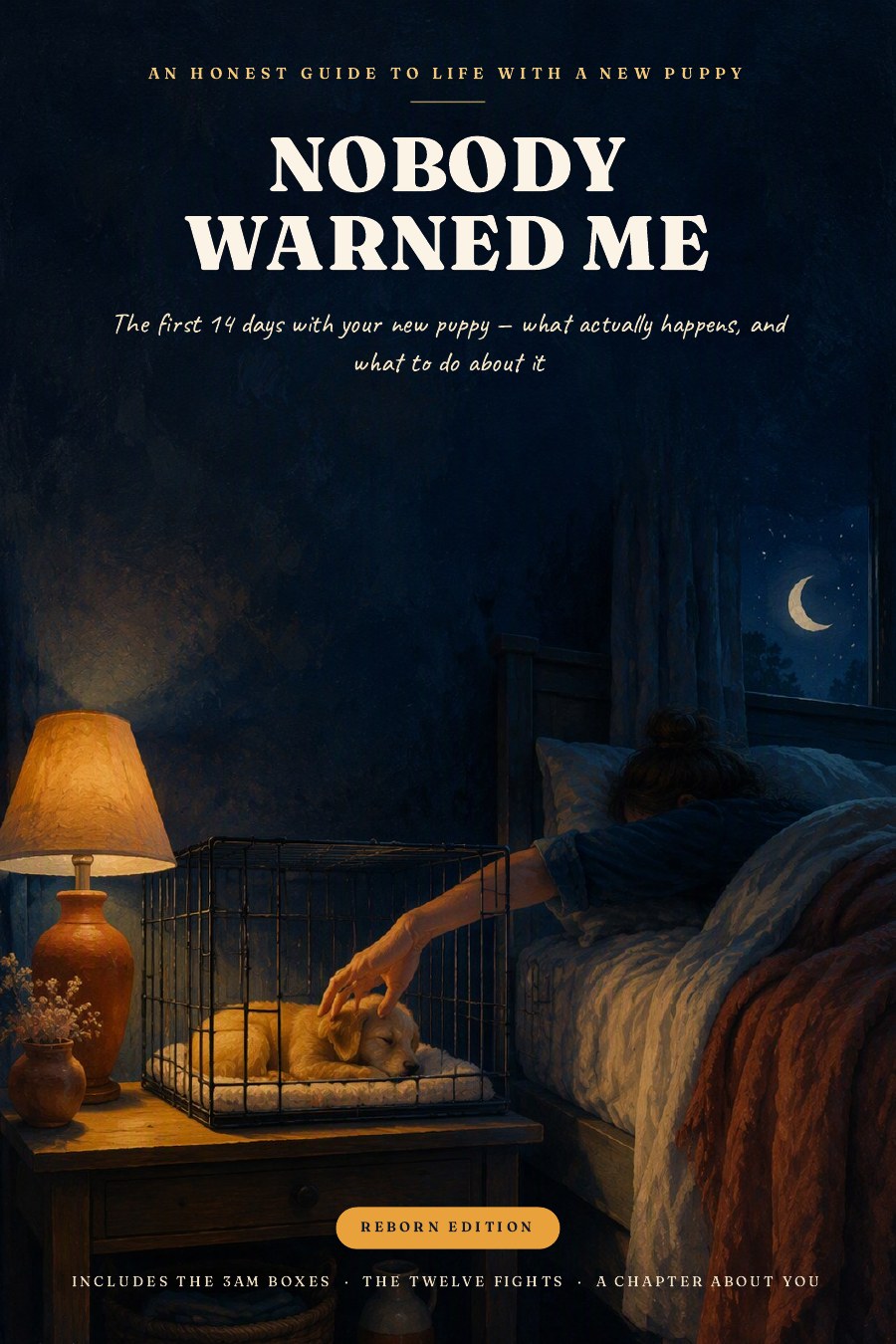
This is one chapter. There are thirteen more.
The biting, the toilet math, the night crying, the schedule that saves your sanity — Nobody Warned Me is the honest survival guide for the first weeks with a new puppy. 116 pages of what to actually do, starting tonight.
Get the survival guide — $29