
Puppy Crying at Night: What's Normal, What's Not, and What to Do Tonight
It's 1:40 a.m. The crying started twenty minutes ago and it is not stopping. Before you do something you'll be undoing for the next six months, read this.
First: this is normal. All of it.
Until tonight, your puppy has never slept alone. Every night of their life so far ended the same way: piled on top of littermates, warm, surrounded by familiar smells and a heartbeat that wasn't theirs. Tonight they're in a strange box, in a strange room, in a house that smells wrong. The crying is not a malfunction. It's a puppy doing exactly what a puppy is supposed to do when separated from their litter: calling for them.
That doesn't mean you ignore it. It means you understand it — because the right response depends entirely on which kind of crying you're hearing.
Protest crying vs. distress crying — learn the difference tonight
Protest crying comes in bursts. Yip-yip-yip... pause... yip-yip... longer pause. It has gaps in it, because your puppy is listening: is anyone coming? A puppy who has been fed, has just been to the toilet, and is safe and warm is protesting the situation, not suffering in it. Protest crying should not be rewarded with a full appearance — because whatever response crying produces on night one is what your puppy will expect on night two, and night thirty.
Distress crying is different: continuous, escalating, panicked. No pauses. No listening. That puppy isn't negotiating — they're overwhelmed, and leaving them to escalate teaches them that panic is the normal state of nighttime. Distress crying gets a calm, quiet response: your voice, your hand through the crate bars, your presence — without turning it into a party.
The setup that settles most puppies in 3–5 nights
Most night-one disasters are setup problems, not puppy problems. Fix the setup and the crying usually collapses on its own:
- Crate at mattress height, right next to your bed. Your puppy can smell you and hear you breathe. You can drop a hand down without getting up. This single change ends more night crying than any gadget ever sold.
- Something that smells like the litter. If you can, bring home a cloth or small blanket rubbed on the littermates or mother. That smell is the single most comforting thing in the world to your puppy right now.
- A heartbeat. A heartbeat toy or a wrapped warm water bottle mimics what they slept against until last night. (Warm, not hot — and nothing they can chew open.)
- Tired before bed. A calm play session and a toilet trip in the last 30 minutes before crate time. A puppy who goes in exhausted protests less.
- Dark, quiet, boring. The room should say "sleep," not "an interesting place to be awake."
The toilet truth nobody tells you
An 8-week-old puppy can physically hold it for roughly 2 to 3 hours overnight. That's not stubbornness — that's bladder size. So don't wait for crying to tell you it's toilet time. Set an alarm for around the 2.5-hour mark and take them out before the crying starts.
The toilet trip itself is where most people accidentally train the crying. The rules: low light, no talking, no play, no eye contact party. Out, toilet, quiet praise, back in the crate. It should be the most boring interaction of your puppy's day. If 2 a.m. is fun, your puppy will book it again tomorrow.
The three mistakes that make night two worse
- "Just for tonight, into our bed." There is no "just for tonight" in puppy learning. Whatever happens on night one becomes the baseline expectation. If the bed is the plan long-term, fine — decide that. If it isn't, don't start it at 2 a.m. because you're tired.
- Rushing in at every peep. Responding to protest crying teaches the puppy that protest works. Check the list — fed? toileted? safe? — and if all three are yes, let the pauses do their work.
- Turning the 2 a.m. toilet trip into a hangout. Talking, lights, play, a little cuddle on the couch. You've just taught your puppy that crying at night produces entertainment.
What the next few nights actually look like
Here's the honest curve, so you don't panic on night two: night one is usually the loudest. Night two is often similar — sometimes worse, because now they're protesting with experience. Nights three to five, the crying shortens dramatically: a few minutes of protest, then sleep. Most puppies with a good setup are sleeping through with one scheduled toilet trip by the end of the first week or two.
If it's getting worse after a week — longer crying, more panic — that's not a willpower problem. Something in the setup is wrong, or your puppy needs a slower plan. Adjust, don't escalate.
Questions everyone asks at 2 a.m.
How long will my puppy cry at night?
Most puppies cry at night for 3 to 5 nights while they adjust to sleeping alone. It usually peaks on night one or two and drops sharply after that — as long as the setup is right and you respond consistently. If it's getting worse after a week, change the setup, not your resolve.
Should I ignore my puppy crying at night?
It depends which crying it is. Protest crying — bursts with pauses, from a fed, toileted, safe puppy — shouldn't be rewarded with attention. Distress crying — nonstop, panicked, escalating — should never be ignored. Tell them apart first, then decide.
Should I let my puppy sleep in my bed on the first night?
You can — but decide deliberately, because night one sets the expectation for every night after. If your long-term plan is a crate, start with the crate at mattress height next to your bed: your puppy gets your presence, and you keep your plan.
How often does an 8-week-old puppy need the toilet at night?
About every 2 to 3 hours. Set an alarm and go before the crying starts — low light, no play, straight back to the crate. Waiting for crying teaches them that crying summons you.
When is crying at night a vet problem?
When it comes with vomiting, diarrhea, refusing food, or distress during the daytime too. Night-only protest is adjustment. Round-the-clock distress is a vet visit.
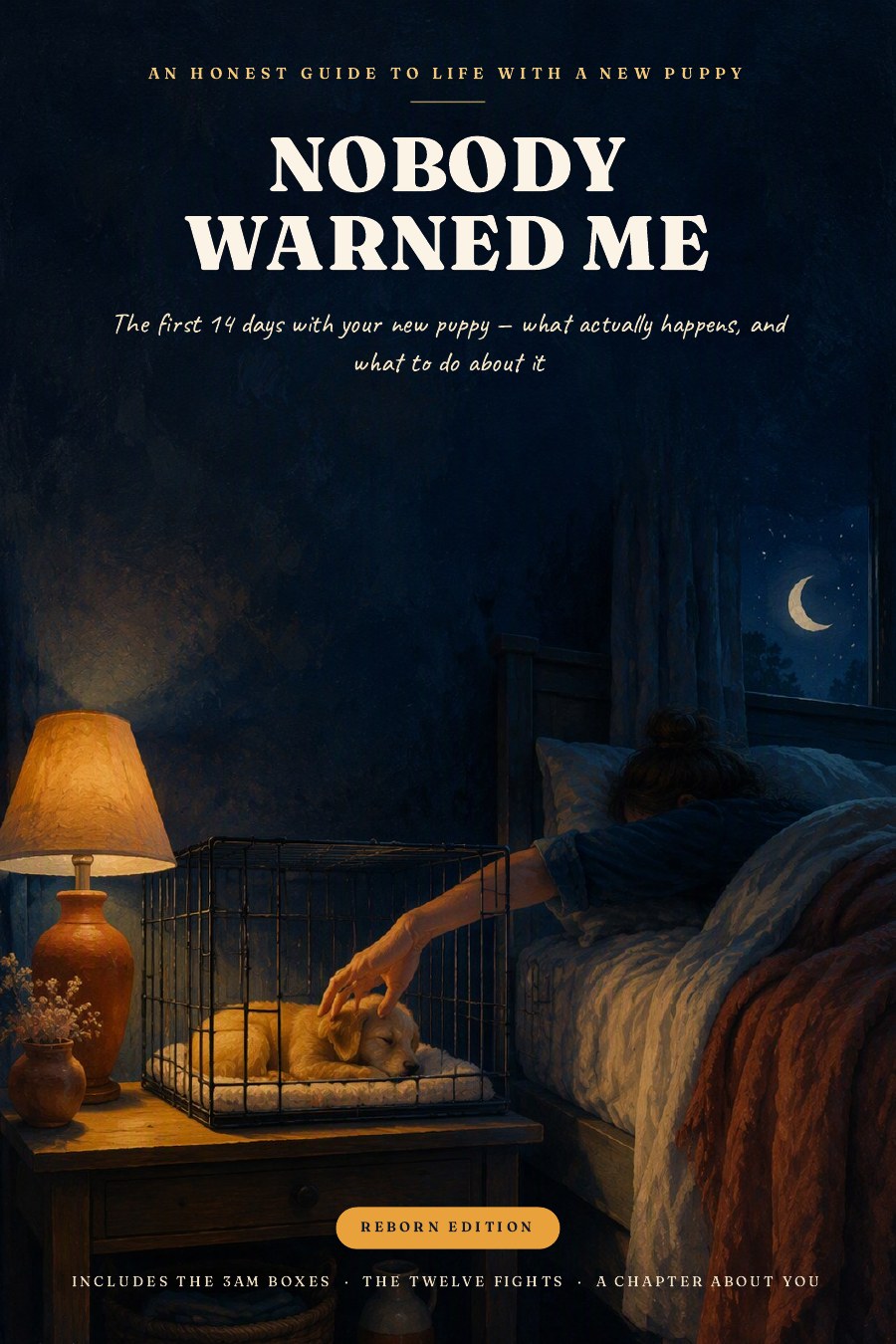
This is chapter one. There are thirteen more.
Night one, the 2 a.m. toilet math, the biting phase, the schedule that saves your sanity — Nobody Warned Me is the honest survival guide for the first weeks with a new puppy. 116 pages of what to actually do, starting tonight.
Get the survival guide — $29